welcome to the haikutimes
Issue #258 October 13, 2024: Abbey St. Marie de Valmagne and Sète

Molière sculpture at night, Pezenas
It’s 5:27 AM, and I’m still trying to adjust to the fact that part of my body is still in Colorado while my reality is eight hours removed, here in the south of France. In our expected time of rest, sleep was difficult to come by, and during the waking hours, I found myself struggling to stay awake.
This was especially true yesterday morning when we had our second lecture about France by the trip leader, Fran. I found the facts and figures put forth by Fran, the esteemed archaeologist, to be the most sleep-inducing moment yet, and I kept fearing he would glance at me while my eyes were falling shut. His detailed description about how the French government works was pertinent, but I found it difficult to stay awake. Even the several cups of espresso that I nabbed before breakfast was not enough to keep me alert!

Fran delivering a lecture about the French political system
Next stop: the Abbey St. Marie de Valmagne. We had to walk through part of Pezenas to get to our bus, as there was a huge outdoor antiques fair going on, filling the streets around the main square. The tour bus, roomy and modern, was driven by Lorenzo, a white-shirted gentleman with a shaved head and a long beard, who took us to about 20 km away to the abbey.
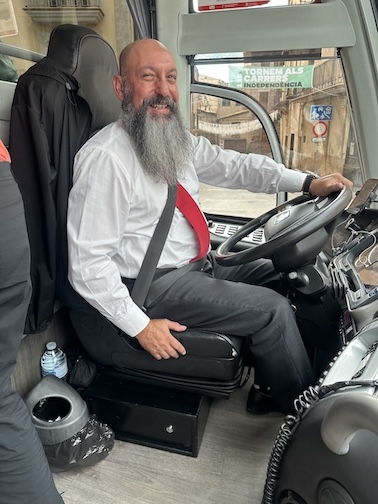
Lorenzo, our bus driver
Originally Benedictine and built in 1138, Abbey St. Marie de Valmagne became a Cistercian Church, until the French Revolution, when it was sold to private interests.

Abbey St. Marie de Valmagne
The Abbey is a huge Gothic structure 272 feet long and 79 feet high, completely remodeled; originally built in 1139. At one time, there had been as many as 300 monks living there.

interior of Abbey St. Marie de Valmagne
It had the air of age, devotion, and it had been converted into a wine cellar, as evidenced by the huge barrels in the church and the vineyards all around supplying the grapes.

The wine casks now have a central place in the abbey
It was a beautiful old structure that unfortunately had had to have all its stained glass windows removed. Over the centuries, the structure had come under attack many times.
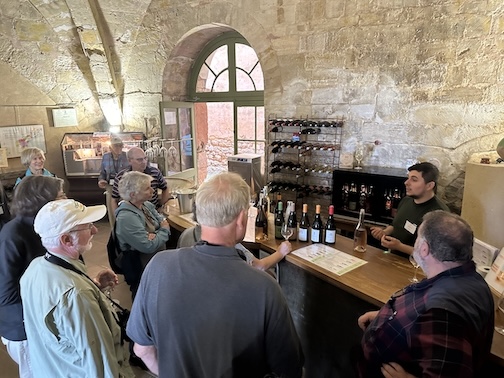
Mid-day wine-tasters
At any rate, wine seemed to be the reason for its existence now, and part of the tour included a wine tasting, which both Mom and I avoided. We had a different guide this time, a gal whose mellifluous voice was clearly transmitted through our digital devices. She wore glasses with thick lenses, which magnified her eyes.

In the courtyard rooms of the Abbey St. Marie de Valmagne
Our next destination was the town of Sète, which was not too far away. Sète is right next to the Mediterranean Sea, and the town has a series of canals that link a large inland lagoon to the sea; and in this lagoon are numerous iron structures where oysters are hung on ropes and grown.
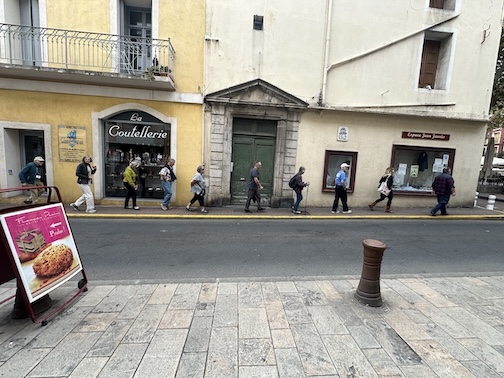
Little travel ducklings following Fran in Sète
We first had lunch in the market near the main square. We ate an interesting pastry with octopus, which Mom and I bought on our own after some confusion about what to get.
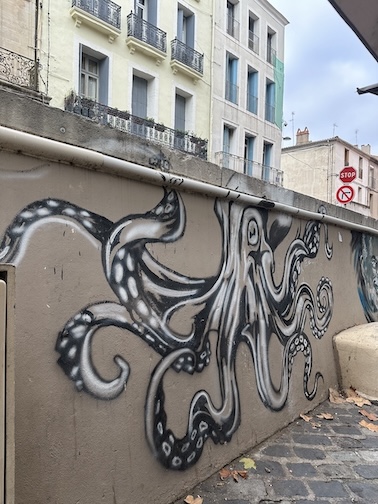
Octopus mural in Sète
In the square was a large octopus sculpture, crowded with pigeons, as well as murals on the walls depicting more octopus. Outside the food market, we also saw plaques of the allied bombings in the town during World War II.
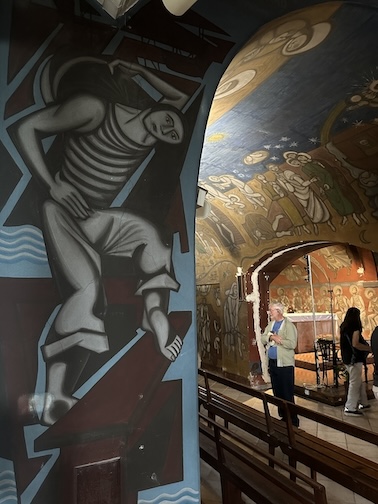
Inside the Chapel of our Lady of La Salette
Before visiting the oyster beds, we took the bus to the top of the mountain overlooking the town, where we could see the layout of the canals, and visited a church at the top, the “Chapel of our Lady of La Salette” which was dedicated to Mary, referencing a vision seen by two children who claimed to have seen the Virgin Mary back in 1846 in Lasalette-Fallavaux, in the Alps. The sanctuary had interesting murals by Jacques Bringuier, mostly blocky frescoes starting to fall apart.
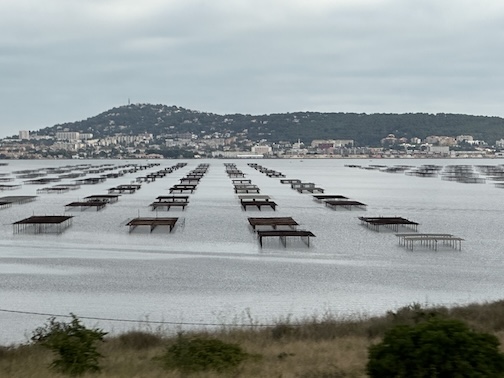
Oyster beds of Sète
The highlight of the day was our visit to an oyster farm. There are apparently about 400 in this area, and each farmer rents out some space in the lagoon from which to embark upon the arduous process of growing oysters, from babies to maturity, which involves gluing them to ropes and keeping them hanging in the water until they are mature. A young guy, 23, was now the proprietor of his family’s business, and through our tour guide, who acted as translator, we learned about his reality. We were all given oysters to eat following his talk. Growing oysters is one of the largest industries of the town; millions are grown here, and exported everywhere. (Oysters are nutritious, but uncooked oysters can be dangerous, so I ate mine with slight concern).
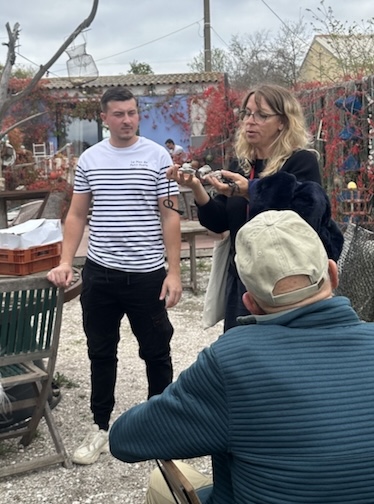
Our tour guide translates for the oyster proprietor
Another highlight of the day involved talking to Orion, who is currently in Antibes, France. He made plane reservations to go to Barcelona, timing the end of his visit when we will be there, so we will see him at the end of our trip! He had just been on a school sponsored trip along with the president of the School of Mines to the famed area of Avignon with its large Roman ruins, just 70 miles from here.

Jon, Judy and Stephen Snyder experiencing oysters
Mom had a pretty crappy sleep last night. She had problems with her sleep apnea machine, which kept ‘burping’ and keeping her awake, and she also had to get up about five times to pee, so she’s quite tired. I had severe tinnitus, and slept only intermittently.
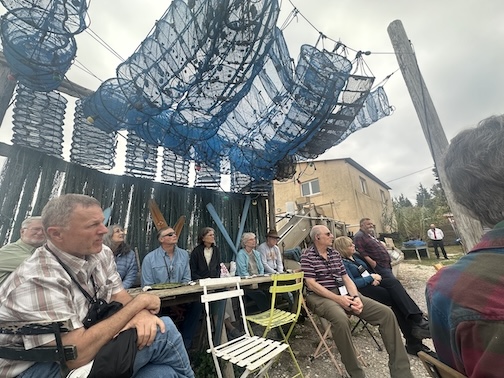
Curious oyster aficionados
One thing I am noticing on this trip is that when I see other contemporary art or a studio run by an artist, I end up thinking how inconsequential it all is, and that makes me ponder the degree of my own inconsequentiality as an artist. I am curious about all this, and it’s reinforced by seeing work from other artists who have up to this point been unknown to me, and whom I will soon forget about. It makes me realize that, to other people, my artwork and passion probably follows the same trajectory.

Our tour bus reflected in a mirror-mural of the Mediterranean sea
For instance, what about Jacques Bringuier, the artist who decorated Our lady of LaSalette, in Sète? His frescoes were falling apart; his expression, blocky and unusual, but still memorable. I looked him up, and saw that he had a long career in the arts. I would never have known about him until I visited Sète, that is for certain.

The canals of Sète, from the inside of our tour bus
Then there is Serge Ivorra, from Pezenas, the carpenter who restores all the doors. It’s good to know about him. His work seems functional, practical and aesthetic; a contrast to the expressive abstract paintings or glasswork that were also featured in the many studios that occupied the ground floor of the buildings of Pezenas.

View of Sète from the highest point (where the church of Our Lady of Salette sits)
Meanwhile, the outside world with its politics and struggles are going on; there’s lots of news from the US about the election. The vice presidential candidate, Vance, denies Trump lost election in 2020, which to me is incredible and scary; white evangelical nationalists had a huge rally in Washington DC, with sickening religious and prophetic overtones; truly scary stuff. It looks like the election will be close; hard to say, but I am truly scared if Trump becomes president again. I expect there will be major disruptions, even violence, and threats to our checks-and-balances style of government.

One more picture of the beautiful Abbey St. Marie de Valmagne
Molière sculpture at night, Pezenas
It’s 5:27 AM, and I’m still trying to adjust to the fact that part of my body is still in Colorado while my reality is eight hours removed, here in the south of France. In our expected time of rest, sleep was difficult to come by, and during the waking hours, I found myself struggling to stay awake.
This was especially true yesterday morning when we had our second lecture about France by the trip leader, Fran. I found the facts and figures put forth by Fran, the esteemed archaeologist, to be the most sleep-inducing moment yet, and I kept fearing he would glance at me while my eyes were falling shut. His detailed description about how the French government works was pertinent, but I found it difficult to stay awake. Even the several cups of espresso that I nabbed before breakfast was not enough to keep me alert!
Fran delivering a lecture about the French political system
Next stop: the Abbey St. Marie de Valmagne. We had to walk through part of Pezenas to get to our bus, as there was a huge outdoor antiques fair going on, filling the streets around the main square. The tour bus, roomy and modern, was driven by Lorenzo, a white-shirted gentleman with a shaved head and a long beard, who took us to about 20 km away to the abbey.
Lorenzo, our bus driver
Originally Benedictine and built in 1138, Abbey St. Marie de Valmagne became a Cistercian Church, until the French Revolution, when it was sold to private interests.
Abbey St. Marie de Valmagne
The Abbey is a huge Gothic structure 272 feet long and 79 feet high, completely remodeled; originally built in 1139. At one time, there had been as many as 300 monks living there.
interior of Abbey St. Marie de Valmagne
It had the air of age, devotion, and it had been converted into a wine cellar, as evidenced by the huge barrels in the church and the vineyards all around supplying the grapes.
The wine casks now have a central place in the abbey
It was a beautiful old structure that unfortunately had had to have all its stained glass windows removed. Over the centuries, the structure had come under attack many times.
Mid-day wine-tasters
At any rate, wine seemed to be the reason for its existence now, and part of the tour included a wine tasting, which both Mom and I avoided. We had a different guide this time, a gal whose mellifluous voice was clearly transmitted through our digital devices. She wore glasses with thick lenses, which magnified her eyes.
In the courtyard rooms of the Abbey St. Marie de Valmagne
Our next destination was the town of Sète, which was not too far away. Sète is right next to the Mediterranean Sea, and the town has a series of canals that link a large inland lagoon to the sea; and in this lagoon are numerous iron structures where oysters are hung on ropes and grown.
Little travel ducklings following Fran in Sète
We first had lunch in the market near the main square. We ate an interesting pastry with octopus, which Mom and I bought on our own after some confusion about what to get.
Octopus mural in Sète
In the square was a large octopus sculpture, crowded with pigeons, as well as murals on the walls depicting more octopus. Outside the food market, we also saw plaques of the allied bombings in the town during World War II.
Inside the Chapel of our Lady of La Salette
Before visiting the oyster beds, we took the bus to the top of the mountain overlooking the town, where we could see the layout of the canals, and visited a church at the top, the “Chapel of our Lady of La Salette” which was dedicated to Mary, referencing a vision seen by two children who claimed to have seen the Virgin Mary back in 1846 in Lasalette-Fallavaux, in the Alps. The sanctuary had interesting murals by Jacques Bringuier, mostly blocky frescoes starting to fall apart.
Oyster beds of Sète
The highlight of the day was our visit to an oyster farm. There are apparently about 400 in this area, and each farmer rents out some space in the lagoon from which to embark upon the arduous process of growing oysters, from babies to maturity, which involves gluing them to ropes and keeping them hanging in the water until they are mature. A young guy, 23, was now the proprietor of his family’s business, and through our tour guide, who acted as translator, we learned about his reality. We were all given oysters to eat following his talk. Growing oysters is one of the largest industries of the town; millions are grown here, and exported everywhere. (Oysters are nutritious, but uncooked oysters can be dangerous, so I ate mine with slight concern).
Our tour guide translates for the oyster proprietor
Another highlight of the day involved talking to Orion, who is currently in Antibes, France. He made plane reservations to go to Barcelona, timing the end of his visit when we will be there, so we will see him at the end of our trip! He had just been on a school sponsored trip along with the president of the School of Mines to the famed area of Avignon with its large Roman ruins, just 70 miles from here.
Jon, Judy and Stephen Snyder experiencing oysters
Mom had a pretty crappy sleep last night. She had problems with her sleep apnea machine, which kept ‘burping’ and keeping her awake, and she also had to get up about five times to pee, so she’s quite tired. I had severe tinnitus, and slept only intermittently.
Curious oyster aficionados
One thing I am noticing on this trip is that when I see other contemporary art or a studio run by an artist, I end up thinking how inconsequential it all is, and that makes me ponder the degree of my own inconsequentiality as an artist. I am curious about all this, and it’s reinforced by seeing work from other artists who have up to this point been unknown to me, and whom I will soon forget about. It makes me realize that, to other people, my artwork and passion probably follows the same trajectory.
Our tour bus reflected in a mirror-mural of the Mediterranean sea
For instance, what about Jacques Bringuier, the artist who decorated Our lady of LaSalette, in Sète? His frescoes were falling apart; his expression, blocky and unusual, but still memorable. I looked him up, and saw that he had a long career in the arts. I would never have known about him until I visited Sète, that is for certain.
The canals of Sète, from the inside of our tour bus
Then there is Serge Ivorra, from Pezenas, the carpenter who restores all the doors. It’s good to know about him. His work seems functional, practical and aesthetic; a contrast to the expressive abstract paintings or glasswork that were also featured in the many studios that occupied the ground floor of the buildings of Pezenas.
View of Sète from the highest point (where the church of Our Lady of Salette sits)
Meanwhile, the outside world with its politics and struggles are going on; there’s lots of news from the US about the election. The vice presidential candidate, Vance, denies Trump lost election in 2020, which to me is incredible and scary; white evangelical nationalists had a huge rally in Washington DC, with sickening religious and prophetic overtones; truly scary stuff. It looks like the election will be close; hard to say, but I am truly scared if Trump becomes president again. I expect there will be major disruptions, even violence, and threats to our checks-and-balances style of government.
One more picture of the beautiful Abbey St. Marie de Valmagne
solo/group kukai
drawing/writing/photography
jonathan machen
drawing/writing/photography
jonathan machen